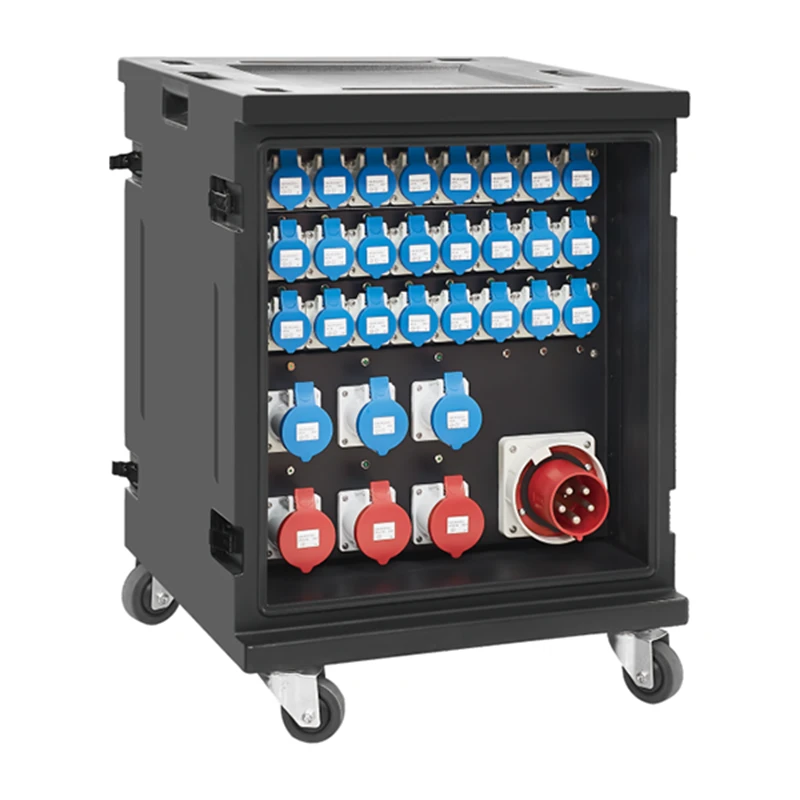
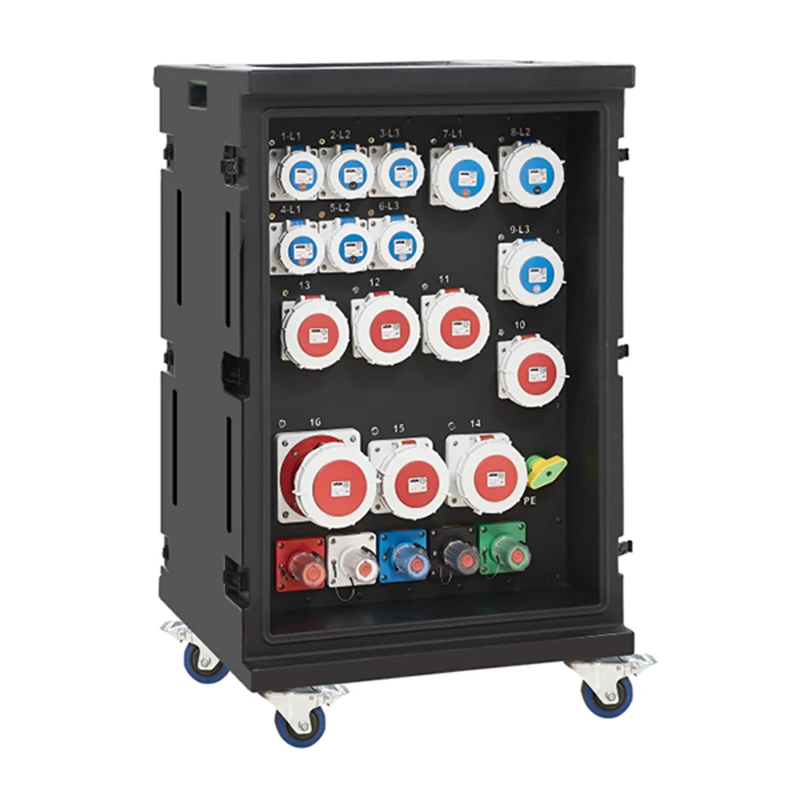


Power Distribution Box with RCD Protection
An RCD does not protect equipment; it protects people. It compares the current going out with the current coming back, and if the difference reaches 30 mA it opens the circuit in milliseconds. On a distribution box that protection has to sit on the outgoing ways, so a fault on one lead trips that lead and nothing else.
We build RCD protection in two ways: an RCBO on each way, which gives every circuit its own residual current device, or a main RCD with individual MCBs where a group is protected together. The choice depends on how the box will be used and on the discrimination required upstream.

RCD Type, Rating and Discrimination
Residual current protection is only reliable when the type matches the load and the delay matches the devices around it.
- 30 mA for socket circuits and portable equipment
- Type A for general AC loads with pulsating DC components
- Type B where drives, chargers or inverters produce smooth DC leakage
- Type S or time-delayed upstream RCD for discrimination
- RCBO per way to avoid a single fault tripping the whole board
- Test button accessible with the door closed
RCD Type Selection
| Type | Detects | Typical Load |
|---|---|---|
| Type AC | Alternating residual current only | Simple resistive and lighting loads |
| Type A | AC plus pulsating DC | Hand tools, sockets, general equipment |
| Type F | AC, pulsating DC and mixed frequency | Single-phase inverters, some chargers |
| Type B | AC, pulsating and smooth DC | Variable speed drives, EV chargers, PV |
Typical Specifications
| Parameter | Options |
|---|---|
| Incoming | Single or three-phase, 32A to 630A |
| Protection Layout | RCBO per way, or main RCD plus MCBs |
| RCD Sensitivity | 30 mA standard, 10 mA or 100 mA on request |
| RCD Type | Type A, F or B to match the load |
| Discrimination | Type S / time-delayed upstream device |
| Outgoing | 16A to 63A CEE, powerCON, socapex |
| Enclosure | Steel, stainless or HDPE, IP54 to IP67 |
| Testing | Trip time and test button check on every way |
| Documentation | Circuit schedule, test record, single-line diagram |
| Standards | IEC 61008 / 61009, IEC 61439-1 / -2, IEC 60309 |
How the RCD Protection Is Tested
- RCDs and RCBOs are selected to IEC 61008 and IEC 61009, with the correct type for the load confirmed on the drawing.
- Each residual current device is trip-tested at the rated residual current and its operating time recorded on the test sheet.
- Polarity, protective earth continuity and insulation resistance are checked on every way.
- Where discrimination is specified, the time-current relationship between outgoing and upstream devices is checked before dispatch.
- A circuit schedule, test record and single-line diagram are supplied, so the installation can be re-tested and logged on site.
Frequently Asked Questions
Should each way have its own RCBO?
On site equipment, usually yes. One RCBO per way means a damaged lead trips only its own circuit, so the rest of the board keeps working. A main RCD is cheaper but takes everything down with it.
Why does my RCD keep tripping?
Nuisance tripping usually comes from accumulated leakage across several items on the same RCD, moisture in a connector, or a load whose leakage is not sinusoidal. Splitting ways, drying and inspecting connectors, or moving to the correct RCD type normally solves it.
Do I need Type B?
Type B is required where smooth DC residual current can appear, typically variable speed drives, some EV chargers and PV inverters. For hand tools and general site equipment, Type A is the usual choice.
Hot Tags: power distribution box with rcd protection, China power distribution box with rcd protection manufacturers, suppliers, factory, cam lock distribution box, cam lock power distribution panel, electrical power distribution box, industrial power distribution box, m12 distribution block, pole top distribution box