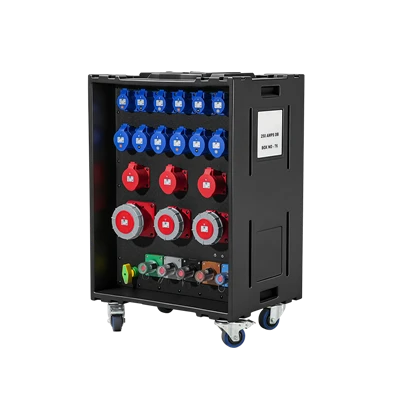

Why HDPE for a Power Distribution Cabinet?
The enclosure is not simply a housing for electrical components.
For temporary power equipment, the enclosure itself has to withstand repeated transportation, installation, removal and exposure to changing site conditions.
This is where HDPE provides a practical alternative to conventional steel enclosures.
HDPE Enclosure Advantages
| HDPE Property | Practical Benefit for Power Distribution |
|---|---|
| High impact resistance | Helps withstand knocks during transportation and site handling |
| Corrosion resistance | Suitable for humid, coastal and corrosive environments |
| Low moisture absorption | Helps maintain enclosure performance in wet environments |
| UV-resistant formulation | Better suited to outdoor exposure |
| Lightweight compared with many metal constructions | Easier transportation and handling |
| Electrical insulation | HDPE is electrically non-conductive |
| Rotomolded construction | Allows robust one-piece enclosure designs |
| Chemical resistance | Useful in industrial and outdoor working environments |
| Thick enclosure walls | Provides additional mechanical protection |
| No metal corrosion | Avoids rust-related enclosure degradation |
The exact environmental performance depends on the HDPE grade, wall thickness, manufacturing process, sealing design and final IP rating.
Rotomolded HDPE Enclosure
For demanding temporary power applications, the manufacturing method of the enclosure matters.
APEKS can use a rotationally molded HDPE enclosure to produce a strong, integrated housing with rounded corners and a robust structure.
Rotational molding is widely used for large polyethylene enclosures because the process can produce complex hollow structures without conventional welded seams. Research on rotationally molded HDPE structures also identifies the process as suitable for producing stress-free structures with strong corners and without weld lines.
For a power distribution cabinet, this construction provides several practical benefits.
Integrated Enclosure Structure
A properly designed rotomolded enclosure can reduce the number of joints and fabricated seams compared with a multi-piece metal housing.
This is particularly useful when the distribution cabinet is repeatedly:
Reinforced High-Stress Areas
For portable distribution equipment, areas around handles, locks, hinges, caster mounts and socket panels are subject to repeated mechanical loads.
These areas can be reinforced according to the cabinet design to improve resistance to repeated handling.
Impact Resistance for Temporary Power Applications
Temporary power distribution equipment does not always stay inside a controlled electrical room. It may be transported in trucks, moved around construction sites or positioned near stages and outdoor working areas.
The enclosure can therefore be exposed to:
HDPE provides good impact resistance and is already used in temporary distribution equipment for this reason. For example, commercial temporary distribution cabinets using thick HDPE/PE enclosures specify impact resistance alongside high rigidity and mechanical protection.
This makes HDPE particularly suitable where the distribution cabinet needs to be portable, reusable and resistant to rough handling.
Corrosion-Resistant Enclosure for Harsh Environments
One of the major differences between HDPE and conventional steel is that HDPE does not rust.
This matters for applications such as:
Metal enclosures may require coatings or surface treatments to manage corrosion. HDPE itself is inherently resistant to many corrosive environments.
For customers operating rental fleets or temporary power equipment, this can be particularly useful because the same distribution cabinet may be repeatedly deployed in different locations.
Outdoor Power Distribution & UV Resistance
HDPE is well suited to outdoor temporary power equipment when combined with an appropriate enclosure design and sealing system.
Depending on the product configuration, APEKS distribution cabinets can be designed with different IP protection levels such as IP44, IP65 or IP67.
The IP rating is determined by the complete enclosure system, including:
Therefore, HDPE material alone does not determine the IP rating. The complete cabinet construction needs to be designed and tested for the required level of ingress protection.
UV-Resistant HDPE for Outdoor Use
Outdoor electrical equipment may remain exposed to sunlight for extended periods. For outdoor distribution cabinets, the HDPE material can be formulated with UV stabilizers to improve resistance to UV exposure.
A black HDPE enclosure containing carbon black is a common approach for improving UV resistance of polyethylene products; studies have specifically examined the effect of carbon black in HDPE under accelerated UV exposure.
For APEKS outdoor distribution products, the material formulation can therefore be selected according to the intended environment and service requirements.
Lighter Alternative to Metal Distribution Cabinets
Large temporary distribution cabinets can become difficult to move when the enclosure, switchgear, copper busbars, cables and connectors are combined. HDPE can reduce enclosure weight compared with many equivalent steel constructions while maintaining a substantial enclosure structure.
This is particularly valuable for:
Event Power
Distribution equipment may need to be moved during stage setup and dismantling.
Construction Sites
The cabinet may need to be relocated as the work area changes.
Rental Equipment
Rental companies frequently transport distribution equipment between projects.
Shipyards & Industrial
Temporary power distribution points may need to be repositioned as work progresses.
Construction Sites
Construction sites require temporary electrical distribution that can withstand changing working conditions. An HDPE distribution cabinet can be configured for:
For larger construction projects, several HDPE distribution cabinets can be used as part of a temporary power distribution network.
APEKS supports distribution architectures from 16A to 800A, allowing the enclosure and internal configuration to be matched to different temporary power requirements.
HDPE Distribution Cabinet for Events
Outdoor events place different requirements on temporary power equipment. The distribution system may need to supply:
An HDPE enclosure provides a practical housing solution where the distribution equipment must be repeatedly transported and used in outdoor environments.
The internal configuration can include different combinations of CEE outlets, MCBs, MCCBs, RCDs, RCBOs, Powerlock connectors and monitoring devices.
HDPE vs Steel Power Distribution Cabinet
| Feature | HDPE Enclosure | Steel Enclosure |
|---|---|---|
| Impact resistance | High | High, depending on construction |
| Corrosion | Does not rust | Requires suitable coating/protection |
| Weight | Generally lighter | Generally heavier |
| Outdoor use | Suitable with correct IP design | Suitable with correct coating/IP design |
| Electrical insulation | Non-conductive enclosure material | Conductive |
| Chemical resistance | Good for many environments | Depends on coating/material |
| Transportation | Easier to handle in many configurations | Usually heavier |
| Custom shape | Suitable for molded enclosure designs | Fabrication-based |
| Temporary applications | Highly suitable | Suitable |
| Rental equipment | Suitable for repeated handling | Suitable with appropriate construction |
HDPE and steel serve different enclosure requirements. HDPE is particularly attractive when impact resistance, corrosion resistance, lower enclosure weight and outdoor/temporary deployment are important.
Internal Electrical Configuration
The HDPE enclosure is only one part of the complete power distribution cabinet. The internal electrical system can be configured according to the required load and distribution architecture.
Possible components include:
The final configuration should be determined from the incoming supply, connected load, circuit arrangement and applicable electrical standards.
Built for Repeated Transport & Deployment
A temporary distribution cabinet is different from a fixed electrical cabinet. It may be moved dozens or hundreds of times during its service life.
Therefore, the mechanical design should consider more than just electrical protection.
APEKS can configure HDPE distribution cabinets with:
These features help adapt the cabinet to rental fleets, event production and construction-site power systems.
Technical Specifications
| Item | Specification |
|---|---|
| Product | HDPE Power Distribution Cabinet |
| Enclosure Material | High-Density Polyethylene (HDPE) |
| Application | Temporary / Outdoor / Industrial Power Distribution |
| Rated Current | 16A–800A configurations available |
| Protection | MCB / MCCB / RCD / RCBO |
| Input | CEE / Powerlock / Camlock / Customized |
| Output | CEE / Industrial Sockets / Customized |
| IP Rating | IP44 / IP65 / IP67 depending on configuration |
| Installation | Portable / Mobile / Temporary |
| Enclosure Process | Rotational Molding options |
| Customization | OEM / ODM |
| Application Sites | Construction / Events / Shipyards / Industrial Sites |


FAQ:
Hot Tags: hdpe power distribution cabinet, China hdpe power distribution cabinet manufacturers, suppliers, factory, HDPE Plastic Power Distribution System, hdpe power distribution box, HDPE Power Distribution Unit, high voltage insulation, portable electric board, rubber box power distribution