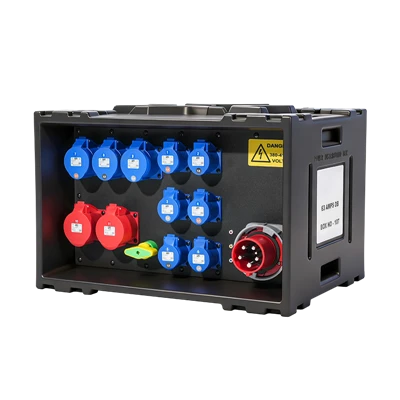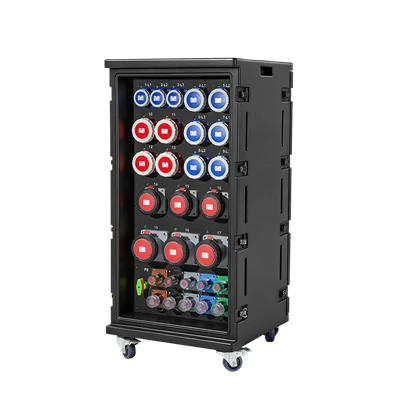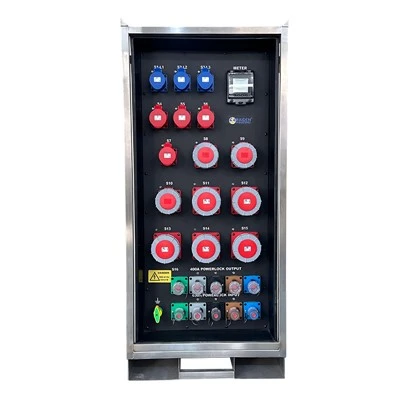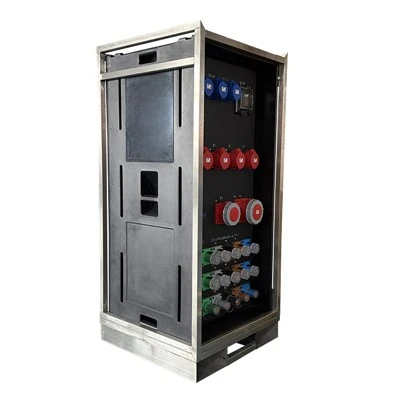
Temporary power distribution boxes transfer electrical power from generators, utility connections, or main feeders to multiple downstream loads during concerts, exhibitions, sports events, outdoor festivals, and construction-stage event installations.
The current rating of the distribution box determines:
Maximum allowable load current
Cable cross-section requirements
Breaker sizing
Connector type
Thermal rise inside the enclosure
Short-circuit withstand capability
An undersized distribution box can trip breakers, overheat conductors, or damage connectors under continuous load. An oversized configuration increases cable cost, transport weight, and generator sizing requirements.
For event systems, common current ratings range from:
16A
32A
63A
125A
250A
400A
The correct rating depends on connected equipment, phase balance, cable length, ambient temperature, and duty cycle.
What Is a Temporary Power Distribution Box
A temporary power distribution box is a portable electrical enclosure that divides incoming electrical power into multiple protected output circuits.
Typical internal components include:
MCCB or MCB circuit breakers
RCCB/RCBO leakage protection
Copper or aluminum busbars
Industrial socket outlets
Power input connectors
Neutral and grounding terminals
Surge protection devices
Outdoor event units commonly use:
Powder-coated steel enclosures
ABS or polycarbonate housings
Stainless steel hardware
IP44 to IP67 protection levels
Most event-grade systems comply with IEC 61439 low-voltage switchgear standards.
Why Current Rating Selection Matters
The current rating defines the thermal and electrical operating limit of the distribution system.
For example:
| Current Rating | Typical Voltage | Approximate Power Capacity |
|---|---|---|
| 16A | 230V single-phase | 3.6 kW |
| 32A | 230V single-phase | 7.3 kW |
| 63A | 400V three-phase | 43 kW |
| 125A | 400V three-phase | 86 kW |
| 250A | 400V three-phase | 173 kW |
| 400A | 400V three-phase | 277 kW |
The actual usable load is usually limited to 80% of breaker rating for continuous operation during multi-hour events.
Example:
A 125A three-phase distribution box is commonly operated below 100A continuous load to reduce thermal stress on breakers and connectors.
Understanding Event Power Loads
Event electrical systems contain mixed inductive and resistive loads.
Typical event loads include:
| Equipment | Load Characteristics |
|---|---|
| LED walls | Switching power supplies |
| Audio amplifiers | High transient current |
| Stage lighting dimmers | Harmonic distortion |
| HVAC units | Motor startup surge |
| Catering equipment | Resistive heating |
| Broadcast systems | Sensitive electronic loads |
Audio amplifiers and motor-driven equipment may generate startup currents 2–6 times higher than nominal running current.
For example:
A 15 kW stage hoist motor may draw over 100A during startup even if running current remains below 30A.
The distribution box must tolerate these transient conditions without nuisance tripping.
Common Current Ratings and Typical Applications
16A Distribution Boxes
16A units are used for:
Small booths
Portable lighting
Mobile DJ systems
Small catering equipment
Typical configuration:
Single-phase 230V
CEE 16A connectors
2.5 mm² copper cable
Maximum continuous load is typically below 3 kW.
32A Distribution Boxes
32A systems support:
Small stages
Portable AV systems
Medium food service zones
Typical structure includes:
32A input connector
Multiple 16A branch outputs
RCBO protection per outlet
These systems commonly use 6 mm² copper conductors.
63A Distribution Boxes
63A temporary power systems are common in medium-sized outdoor events.
Typical applications:
Small concert stages
Tent distribution systems
Mobile generator distribution
A 63A three-phase system can distribute approximately 43 kW at 400V.
Typical connectors:
IEC 60309 63A 5-pin
Powerlock branch outputs in some touring systems
125A Distribution Boxes
125A systems are widely used in professional stage power distribution.
Applications include:
Large LED walls
Touring sound systems
Broadcast compounds
Festival power zones
Typical structure:
Main MCCB incomer
Copper busbar assembly
Multiple 32A and 63A outputs
Phase indication meters
Cable cross-sections commonly range from 35 mm² to 50 mm² copper.
250A–400A Distribution Boxes
These systems are used as primary event distribution nodes.
Applications include:
Main festival power distribution
Generator synchronization systems
Large sports events
Multi-stage concert sites
Typical engineering features:
Busbar chamber separation
Camlock or Powerlock connectors
Generator changeover switches
Load monitoring instrumentation
400A systems may require forced ventilation when installed in enclosed technical rooms.
Single-Phase vs Three-Phase Distribution
Single-phase systems typically operate at:
P=VIP = VIP=VI
Three-phase systems operate at:
P=3VIP = \sqrt{3}VIP=3VI
Three-phase distribution reduces conductor current for high-power loads.
Example:
A 60 kW load at 400V three-phase draws approximately 87A.
The same load on 230V single-phase would require over 260A, increasing cable size and voltage drop significantly.
Large event installations therefore use three-phase distribution for:
Main feeders
Stage distribution
HVAC systems
Generator outputs
Load Calculation Method for Event Power Systems
Temporary event systems are usually designed using demand diversity and continuous load calculations.
Basic calculation steps:
List all connected equipment
Record rated current or power
Separate continuous and intermittent loads
Apply diversity factor
Add startup surge allowance
Apply safety margin
Example:
| Equipment | Power |
|---|---|
| LED wall | 18 kW |
| Audio system | 25 kW |
| Lighting | 20 kW |
| Catering | 12 kW |
Total connected load:
Ptotal=18+25+20+12=75 kWP_{total}=18+25+20+12=75\text{ kW}Ptotal=18+25+20+12=75 kW
For a 400V three-phase supply:
I=P3VI = \frac{P}{\sqrt{3}V}I=3VP
Approximate operating current:
108A
A 125A distribution box would normally be selected instead of 63A.
Cable Size and Connector Compatibility
The distribution box rating must match:
Cable ampacity
Connector rating
Breaker protection
Ambient temperature conditions
Typical copper conductor sizes:
| Current | Recommended Copper Cable |
|---|---|
| 16A | 2.5 mm² |
| 32A | 6 mm² |
| 63A | 16 mm² |
| 125A | 35–50 mm² |
| 250A | 95 mm² |
| 400A | 185 mm² |
Long cable runs increase voltage drop.
For example:
A 125A feeder over 80 meters may require larger conductors than standard ampacity tables indicate.
Environmental Conditions and IP Protection
Outdoor event environments expose distribution boxes to:
Rainwater
Mud
UV radiation
Mechanical impact
Dust ingress
Cable tension
Common protection levels:
| IP Rating | Protection Level |
|---|---|
| IP44 | Splash protection |
| IP65 | Dust-tight + water jets |
| IP67 | Temporary immersion |
Outdoor music festivals commonly use IP65 rubber-sealed connectors and gasketed enclosures.
Metal enclosures may require corrosion-resistant coatings in coastal environments.
Protection Devices Inside the Distribution Box
Temporary power systems usually contain layered protection devices.
Typical protection structure:
| Device | Function |
|---|---|
| MCCB | Main overcurrent protection |
| MCB | Branch circuit protection |
| RCCB | Earth leakage protection |
| SPD | Surge suppression |
| Phase monitor | Phase loss detection |
RCCB sensitivity is commonly:
30 mA for personnel protection
100–300 mA for equipment protection
Incorrect RCCB coordination can cause full-system shutdown during a single branch fault.
Common Failure Modes in Temporary Event Power Systems
Overloaded Connectors
High contact resistance generates localized heating.
Common causes:
Loose terminals
Undersized connectors
Moisture contamination
Thermal damage often appears on neutral pins first in unbalanced systems.
Voltage Drop
Long feeder cables reduce voltage at downstream equipment.
Symptoms include:
Amplifier shutdown
LED flickering
Motor overheating
Voltage drop becomes significant in systems above 50 meters.
Phase Imbalance
Single-phase loads connected unevenly across phases create neutral overheating.
Large lighting systems commonly generate imbalance if phase allocation is not monitored.
Water Ingress
Damaged gaskets or open outlets allow moisture entry.
Water ingress can trigger RCCB tripping or busbar corrosion.
Integration With Generators and Shore Power
Temporary event distribution boxes often connect to:
Diesel generators
Utility service panels
Generator synchronization systems
Generator-fed systems require:
Neutral-ground bonding verification
Frequency stability monitoring
Correct phase rotation
Earthing system inspection
Typical generator outputs for events:
| Event Size | Generator Range |
|---|---|
| Small stage | 20–60 kVA |
| Medium concert | 100–250 kVA |
| Festival site | 500 kVA+ |
A 400A distribution system is commonly paired with generators above 250 kVA.
Example Power Configuration for Different Event Sizes
Small Indoor Booth
Load: 2–3 kW
Distribution: 16A single-phase
Outputs: 4 × 230V sockets
Medium Outdoor Stage
Load: 35–50 kW
Distribution: 63A three-phase
Generator: 80–100 kVA
Large Festival Stage
Load: 80–150 kW
Distribution: 125A–250A
Multiple downstream sub-distribution panels
Multi-Zone Festival Site
Load: 250–500 kW
Distribution: 400A main feeder
Generator synchronization system
Powerlock or Camlock feeder connections
Is a 63A distribution box enough for a concert stage?
A 63A three-phase system supports approximately 43 kW at 400V. Small stages with LED lighting and moderate audio systems may operate within this range. Large line-array audio systems and video walls usually require 125A or higher distribution.
Why are three-phase systems preferred for events?
Three-phase distribution reduces conductor current, improves phase balancing, and supports large motor or amplifier loads with lower voltage drop.
What connector types are used in event power distribution?
Common connectors include:
IEC 60309 industrial plugs
Powerlock connectors
Camlock connectors
Schuko branch outlets for low-current circuits
How much spare capacity should be reserved?
Event systems commonly reserve 20–30% spare current capacity for transient loads, additional equipment, and future expansion.