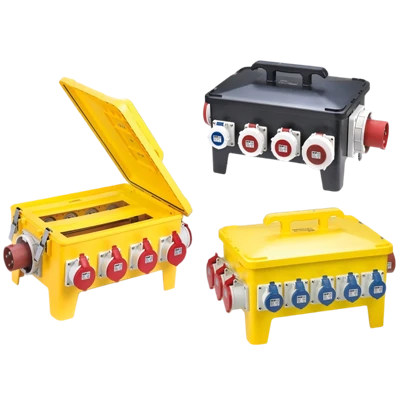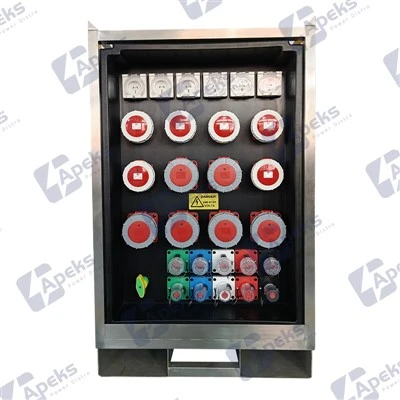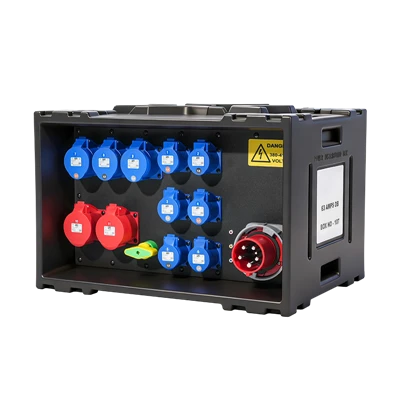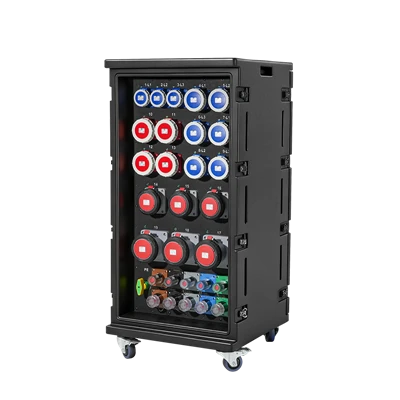
The main advantage of a stackable design is how it supports equipment organization. Separate units can serve different circuit groups, voltage requirements, or work zones while occupying a smaller footprint. However, stacking must follow the manufacturer's design instructions. A distribution box should not be placed on another unit simply because its enclosure appears flat or stable.

How Does a Stackable Design Save Installation Space?
Temporary power installations often need to accommodate distribution equipment alongside cable reels, lighting fixtures, tools, and other electrical accessories. When several distribution boxes are arranged side by side, they can occupy a considerable amount of floor space and obstruct access routes.
A stackable configuration allows compatible units to occupy a shared vertical footprint. For example, an event contractor may use separate boxes for lighting circuits, audiovisual equipment, and service outlets. Arranging the units in a designed stack can keep the distribution area more compact while preserving access to the required connections.
This arrangement is particularly useful in:
- Stage and event production: Organizing multiple distribution units near a designated technical area.
- Construction projects: Keeping temporary power equipment within a defined work zone.
- Equipment rental operations: Arranging prepared distribution units in storage areas and transport vehicles.
- Temporary workshops: Grouping separate circuit supplies where floor space is limited.
Space savings depend on the box dimensions, stacking method, cable connections, and clearance requirements. Buyers should confirm that switches, sockets, handles, and protective devices remain accessible after installation. A compact arrangement should never obstruct emergency access or prevent operators from isolating a circuit safely.
Separate Circuit Groups Without Scattering Equipment
Large temporary installations may require different distribution points for different equipment groups. A single enclosure may not provide all the required outlets or circuit arrangements, particularly when lighting, sound equipment, service tools, and auxiliary loads have different electrical requirements.
Stackable distribution boxes allow compatible units to be grouped physically while retaining their individual circuit arrangements. One unit might serve a designated set of outlets, while another handles a separate group of loads. The exact arrangement depends on the electrical design and the configuration of each box.
For procurement teams, the key consideration is whether the units can be identified and operated independently. Clear circuit labels, visible ratings, and accessible protective devices help technicians distinguish the role of each enclosure.
A practical configuration should define:
- Which loads are connected to each distribution box.
- The incoming supply and electrical rating of every unit.
- The upstream circuit or feeder supplying each box.
- The required isolation and protection arrangements.
- The cable routes between the supply point and the connected equipment.
Stacking helps organize the physical layout, but it does not automatically create an electrical connection between the boxes. Each unit must be supplied and connected according to its intended configuration.
How Can Stackable Boxes Improve Transport and Storage?
Distribution equipment is often moved between warehouses, vehicles, event venues, and construction sites. When boxes have compatible stacking features, they can be arranged in a more organized way during storage and transport, reducing the need to position every unit independently.
Purpose-designed stacking interfaces, locating features, or compatible frames can help maintain alignment. Their suitability depends on the enclosure design and the transport conditions. A stack that is stable in a stationary storage area may require additional restraints when transported by vehicle.
Before selecting stackable distribution boxes, buyers should assess several handling requirements:
- Stacking compatibility: Confirm that the units are designed to stack together, including any differences in size or enclosure format.
- Load limits: Check the permitted stacking height and weight limits specified by the manufacturer.
- Transport restraints: Determine how the units should be secured against movement during transit.
- Connection protection: Ensure that sockets, switches, covers, and cable entries will not be damaged by adjacent units.
- Handling access: Check whether workers can safely lift, separate, and reposition the boxes.
For rental companies, these details can also affect return handling and equipment inspection. Standardizing the box dimensions and stacking method across a product fleet may simplify storage planning and reduce confusion when preparing equipment for dispatch.
What Should Buyers Check Before Stacking Distribution Boxes?
Not every distribution box is designed for stacking. The enclosure, base, frame, and any locking features must support the intended arrangement. Placing incompatible units on top of each other can cause instability, damage to connectors, restricted ventilation, or blocked access to operating components.
Buyers should confirm the following points before ordering:
|
Design factor |
What to verify |
|---|---|
|
Stacking structure |
Whether the enclosure includes a designed stacking interface or compatible frame |
|
Permitted stack height |
Manufacturer's limit for the intended stationary or transport arrangement |
|
Mechanical stability |
Resistance to shifting, tipping, or separation under expected conditions |
|
Weight distribution |
Whether the lower unit can support the specified load above it |
|
Component access |
Clear access to switches, protective devices, handles, and sockets |
|
Ventilation |
Required clearances around heat-generating components |
|
Environmental protection |
Whether stacking affects covers, seals, cable entries, or the specified IP protection |
|
Cable routing |
Safe paths for incoming and outgoing cables without pinching or excessive bending |
The manufacturer's instructions should determine the permitted stacking arrangement. Buyers should also consider the surface where the boxes will be placed. Uneven ground, vibration, and vehicle movement can introduce risks that do not exist on a stable indoor floor.
Cable Management in a Stacked Configuration
Stacking changes the way cables enter and leave a distribution area. When multiple boxes are positioned vertically, cable routes must be planned so that outgoing leads do not become trapped between enclosures or pull against socket connections.
For example, cables from the upper box may need to descend along a designated side of the stack, while the incoming feeder enters through a separate route. The actual layout depends on the socket positions, cable lengths, enclosure design, and site restrictions.
A practical cable arrangement should address three issues.
- Connection strain: Cables should not hang from sockets in a way that places excessive mechanical force on plugs or connectors. Cable supports or strain-relief features should be used where the design requires them.
- Physical protection: Cables should be kept away from sharp edges, moving equipment, vehicle routes, and areas where people may trip over them. If a cable crosses a walkway, suitable cable protection or an alternative route may be necessary.
- Circuit identification: When several boxes are grouped together, cable labels should correspond to the distribution plan. This helps technicians identify the correct feeder or outgoing circuit during inspection and troubleshooting.
A tidy cable layout also makes it easier to separate the boxes when the installation needs to be dismantled or rearranged.
How Does Modular Distribution Support Changing Project Needs?
A stackable distribution system can be arranged around the requirements of a particular installation. A small project may need only one box, while a larger setup may require multiple units to handle different outlet groups or operating areas. Compatible enclosures can provide a consistent physical arrangement as the configuration changes.
For event contractors, the number and type of distribution units may vary with stage size, lighting equipment, sound systems, and temporary service requirements. Construction projects may require different arrangements as work progresses between floors or sections of a site.
However, modularity does not mean that every box can be added without checking the electrical system. Each additional unit introduces requirements for supply capacity, feeder protection, cable ratings, and circuit allocation. The total load must remain within the limits of the upstream supply and all connected components.
When planning a modular arrangement, buyers should prepare an equipment list and identify which loads belong to each box. This provides a basis for selecting the number of units, outlet configurations, current ratings, and required protection devices.
Are Stackable Distribution Boxes Suitable for Outdoor Use?
Stackable distribution boxes can be used in outdoor applications when their enclosures, connectors, and installation arrangements are suitable for the expected environment. The stacking feature itself does not establish protection against rain, dust, impact, or other environmental conditions.
An IP rating describes protection against the ingress of solid objects and water under specified test conditions. Buyers should confirm the rating of the complete assembly and whether the stacking arrangement affects covers, cable entries, or other protected interfaces.
For outdoor events and construction sites, consider the following:
- Whether the ground is level and capable of supporting the stacked units.
- Whether the enclosure is suitable for expected rain, dust, and temperature conditions.
- Whether connectors and covers remain properly closed during operation.
- Whether the stack requires a protective shelter or additional mechanical restraint.
- Whether cables can be routed without collecting water or creating trip hazards.
Where wind, vibration, vehicle movement, or uneven ground may affect stability, the installation needs an appropriate securing method. Environmental protection and mechanical stability should be assessed separately because a box can meet an IP rating while still being unsuitable for an unstable stacking arrangement.
How to Select the Right Stackable Distribution Box
The right product should meet both the electrical requirements and the physical demands of the installation. Buyers should confirm the following information before requesting a quotation.
|
Selection item |
Information to provide |
|---|---|
|
Application |
Stage production, construction, rental use, workshop, or another environment |
|
Incoming supply |
Voltage, phase, frequency, current rating, and connector type |
|
Connected loads |
Equipment list, load requirements, and operating conditions |
|
Output configuration |
Socket types, quantities, and circuit allocation |
|
Protection |
Required overcurrent and residual-current protection |
|
Stacking arrangement |
Number of boxes, stacking method, and permitted height |
|
Enclosure requirements |
Material, IP rating, impact exposure, and indoor or outdoor use |
|
Handling and transport |
Unit weight, lifting method, storage dimensions, and transport restraints |
|
Identification |
Circuit labels, warning markings, and documentation |
|
Compliance |
Applicable electrical standards and project requirements |
Buyers should also clarify whether the boxes will remain stacked during operation, be stacked only for storage, or be transported as a secured group. These scenarios can require different mechanical arrangements.
Stackable Distribution Box Solutions from APEKS ELECTRIC
APEKS ELECTRIC CO., Ltd. supplies power distribution equipment for temporary events, construction sites, stage applications, and industrial use. For projects that require stackable distribution boxes, product selection should begin with the number of distribution points, the connected loads, and the conditions under which the boxes will be installed and transported.
When discussing project requirements, buyers can provide:
- Electrical specifications: Incoming supply details, current ratings, outlet types, and protection requirements.
- Stacking requirements: The planned number of units, available floor space, and whether stacking is required during operation, storage, or transport.
- Enclosure conditions: Expected exposure to moisture, dust, impact, and temperature changes.
- Cable arrangements: Feeder connections, outlet locations, cable lengths, and routing restrictions.
- Project documentation: Applicable standards, circuit identification requirements, and inspection needs.
These details help establish whether a standard enclosure arrangement is suitable or whether the project needs a different configuration. Electrical capacity, enclosure protection, and stacking limits should be confirmed before the equipment is deployed.

3 Phase 400V Stackable Power Distro

63A 3 Phase Stackable Power Distribution Box

Stackable Mobile 63 Amp Power Distributor