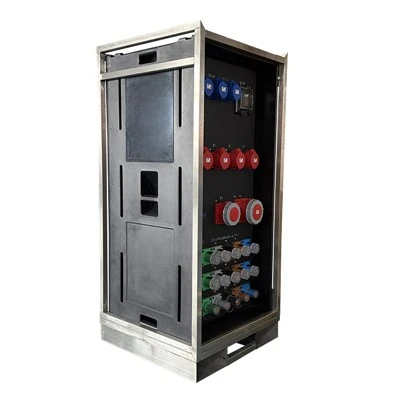
A 63A industrial power distribution box is commonly used when a shipyard, workshop, construction site, or maintenance facility needs to distribute power from a high-current supply to several downstream electrical tools and equipment.
For professional applications, choosing a distribution box is not simply a matter of checking whether it has a 63A inlet and several outlets. The electrical configuration, branch protection, enclosure construction, IP rating, internal wiring, component quality, testing procedures, and available documentation all affect how the unit performs in daily operation.
For shipyards and workshops, the selection process should therefore start with the actual electrical load and working environment rather than the appearance or number of sockets.
63A Industrial Distribution Box Buyer's & Specification Guide
Technical considerations, protection architectures, and quality parameters for shipyard, marine, and workshop heavy-duty distribution assemblies.
1. Start With the Required 63A CEE Configuration
A typical three-phase industrial distribution box may use a 63A 5-pin CEE inlet rated for 400V, 50Hz.
The 5-pin configuration normally consists of:
- L1
- L2
- L3
- Neutral
- Protective Earth
The downstream outlets are then protected and distributed according to the equipment connected to the box.
For example, a workshop may require:
| Circuit | Typical Outlet | Typical Application |
|---|---|---|
| Main input | 63A 5P CEE | Incoming three-phase supply |
| Branch 1–3 | 32A 5P CEE | Welding equipment, machinery, larger tools |
| Branch 4–6 | 16A 5P CEE | Smaller three-phase equipment |
A configuration such as 1 × 63A input + 3 × 32A outputs + 3 × 16A outputs can provide multiple connection points while keeping the outgoing circuits individually protected.
However, the total nominal rating of all outlets should not automatically be treated as the available simultaneous load. The 63A incoming supply remains the principal limitation.
Why load distribution matters
Three-phase loads should be distributed appropriately across L1, L2 and L3 where applicable.
Poor circuit allocation can result in:
- phase imbalance
- unnecessary current on individual phases
- nuisance tripping
- increased conductor temperature
- reduced usable capacity
A professional distribution box should therefore have a clearly defined wiring diagram showing how the incoming supply is connected to each outgoing circuit.
2. Check the Protection Architecture, Not Just the Socket Configuration
The protective devices inside the box are one of the most important parts of the specification.
A 63A distribution box may incorporate different combinations of:
- Main switch
- MCCB
- MCB
- RCD
- RCBO
- Protective-earth connection
The correct arrangement depends on the electrical design, connected equipment and applicable installation requirements.
RCD vs. RCBO
An RCD provides residual-current protection but does not normally provide the same overcurrent protection function as an MCB.
An RCBO combines residual-current protection with overcurrent protection for an individual circuit.
For a distribution box with multiple outgoing outlets, individual RCBO protection can provide circuit-level protection and make it easier to isolate a fault affecting one branch.
For example:
| Outlet | Possible Protection |
|---|---|
| 32A CEE | 32A RCBO |
| 32A CEE | 32A RCBO |
| 32A CEE | 32A RCBO |
| 16A CEE | 16A RCBO |
| 16A CEE | 16A RCBO |
| 16A CEE | 16A RCBO |
This is only an example configuration. The actual ratings, pole arrangement, residual-current characteristics and coordination should be determined from the electrical design and applicable local requirements.
Ask for the actual protection specifications
Instead of accepting a quotation that simply says "RCD protection included," a professional buyer should request:
- RCD/RCBO type
- rated current
- residual operating current
- trip characteristics
- number of poles
- manufacturer
- breaking capacity
- applicable standard
This information makes it possible to compare two distribution boxes based on their actual electrical architecture rather than their appearance.
3. IP67 Can Be Important in Shipyard and Humid Environments
Shipyards and marine workshops can expose electrical equipment to water, humidity, dust, metal particles, oil, dirt and mechanical impact.
For this reason, enclosure protection should be evaluated according to the actual installation environment.
An IP67 enclosure provides a higher level of ingress protection than a basic indoor distribution box. However, IP67 should not simply be treated as a marketing label.
The manufacturer should be able to provide information about how the enclosure achieves the claimed protection level.
Important construction details include:
- enclosure design
- gasket construction
- cable entry
- socket mounting
- door or cover sealing
- fasteners
- unused openings
- strain relief
- test conditions
A high-IP enclosure can lose its effective protection if cable entries, covers or fittings are poorly designed.
For mobile workshop equipment, the protection of the complete assembly is more important than the nominal IP rating of the empty enclosure.
4. Choose the Enclosure Material for the Working Environment
Industrial distribution boxes can use different enclosure materials, including:
- PC/ABS
- HDPE
- thermoplastic materials
- rubber
- stainless steel
- painted or coated metal
There is no universal best material.
The selection should consider:
Impact resistance
A mobile distribution box may be moved around workshops, vessels and construction areas. The enclosure should withstand normal mechanical handling.
Chemical and environmental exposure
Shipyards may expose equipment to salt, moisture, oils, cleaning chemicals and other contaminants.
Weight
A portable box needs to balance mechanical strength with manageable weight.
Temperature
The enclosure and internal electrical components should be suitable for the expected ambient temperature.
Serviceability
A box used professionally should allow technicians to inspect and service the internal components without unnecessary difficulty.
5. Pay Attention to Internal Wiring and Conductors
The outside of a distribution box can look robust while the internal construction varies significantly between manufacturers.
When comparing suppliers, ask about:
- conductor cross-sections
- conductor insulation
- copper busbars
- terminal blocks
- crimping methods
- ferrules
- PE connections
- neutral connections
- cable routing
- wire identification
- torque-controlled connections where applicable
Internal conductors should be appropriately sized for their intended current and installation conditions.
The design also needs to account for heat generated by multiple circuits operating simultaneously.
This is one reason why simply comparing the number of sockets or the thickness of the enclosure does not provide enough information about the actual quality of a distribution box.
6. Look for a Clear Wiring or Single-Line Diagram
A professional 63A distribution box should have a clearly defined electrical architecture.
A simplified configuration might look like:
The actual circuit can be more complex depending on the protection strategy.
A wiring diagram or single-line diagram should identify:
- incoming conductors
- main protective device
- neutral
- protective earth
- RCD/RCBO
- MCB/MCCB
- branch circuits
- outlet ratings
- phase allocation
This document is particularly useful when the distribution box is being integrated into a professional workshop environment or maintained by electricians.
7. Verify IEC 60309 Components
For industrial three-phase power distribution, IEC 60309 is an important reference for industrial plugs, sockets and couplers.
When specifying a 63A distribution box, buyers should check the actual inlet and outlet configuration rather than only looking for the words "CEE socket."
Important specifications include:
- current rating
- voltage
- number of poles
- clock position where applicable
- IP rating
- manufacturer
- certification
- mechanical construction
For example, a 63A 5-pin 400V inlet is not interchangeable with a different current rating simply because both products are described as CEE connectors.
If the equipment will be used in Germany or elsewhere in Europe, the compatibility of the connector system with the local installation should be confirmed before purchase.
8. Ask About IEC 61439 Requirements for the Assembly
For low-voltage switchgear and controlgear assemblies, the relevant IEC 61439 series should also be considered where applicable to the particular distribution assembly.
The important point for buyers is that compliance should not be reduced to a logo or a short statement on a quotation.
Ask the manufacturer:
- Which IEC 61439 part applies to the assembly?
- What design verification has been performed?
- What routine verification is carried out on each finished unit?
- What electrical ratings have been verified?
- Is a technical file or test documentation available?
The exact applicable standard depends on the design and intended application, so the manufacturer should identify the relevant requirements rather than simply listing every possible IEC standard.
9. Factory Testing Should Be Part of the Purchase Specification
For professional industrial equipment, factory testing is an important part of quality control.
A manufacturer should be able to explain how finished distribution boxes are checked before shipment.
Typical verification items may include:
Protective conductor continuity
The PE circuit is checked to verify continuity through the protective-earth path.
Insulation resistance
Insulation resistance testing helps identify insulation problems between relevant conductors and earth.
Dielectric withstand
A dielectric strength test can be used to verify the insulation system under the specified test conditions.
RCD/RCBO function
Where RCD or RCBO devices are installed, their operation should be verified according to the manufacturer's testing requirements and applicable standards.
Wiring verification
The manufacturer should verify that:
- phase connections are correct
- neutral connections are correct
- protective-earth connections are correct
- branch circuits correspond to their labels
- components are correctly installed
Functional testing
The completed assembly should be checked as a complete unit rather than relying only on component-level inspection.
For a sample unit, it is reasonable for a professional buyer to request an individual final-test record.
10. Documentation Is Part of the Product
For professional use in Germany, the electrical product itself is only one part of the purchasing decision.
The accompanying documentation can be equally important.
Depending on the product and applicable legislation, documentation may include:
- EU Declaration of Conformity
- applicable EN/IEC standards
- technical datasheet
- wiring diagram
- operating instructions
- product identification
- rating label
- test records
- component documentation
- IP test documentation where applicable
A supplier saying "CE available" is not the same as providing the actual Declaration of Conformity and supporting technical documentation.
Buyers should review the documents before placing larger orders, particularly when the equipment will be sold onward to professional customers.
11. Consider the Difference Between a Sample Unit and a Production Unit
For a new supplier relationship, purchasing one sample unit can be more informative than relying entirely on a catalogue.
A sample can be evaluated for:
- enclosure construction
- socket quality
- wiring workmanship
- component brands
- labels
- mechanical assembly
- portability
- IP sealing
- documentation
- electrical testing
- packaging
The buyer can then compare the physical product against the supplier's technical quotation.
For distributors, this is also useful because the sample establishes a baseline for future production.
If the supplier later changes components, enclosure materials or electrical protection devices, the buyer can compare the production version against the approved sample.
12. Consider Serviceability and Spare Parts
A professional workshop may use its distribution box repeatedly for years.
Therefore, component availability matters.
Before ordering, ask:
- Can the RCD/RCBO be replaced?
- Are MCBs standard DIN-rail components?
- Are socket assemblies replaceable?
- Are covers and gaskets available?
- Can the cable gland or strain relief be replaced?
- Are wiring diagrams supplied for maintenance?
- Can spare electrical components be purchased separately?
A modular design can make future maintenance easier than a highly integrated construction where individual components cannot be replaced.
13. Compare Suppliers Using a Technical Checklist
When comparing several 63A distribution box manufacturers, a technical comparison table can prevent the decision from being based mainly on price.
| Item | What to Check |
|---|---|
| Input | 63A, 5-pin, 400V, 50Hz |
| Outputs | 32A / 16A CEE configuration |
| Protection | RCD / RCBO / MCB / MCCB |
| RCD rating | Actual residual-current specification |
| Enclosure | PC/ABS, HDPE, metal or other material |
| IP rating | IP44 / IP54 / IP65 / IP67 as applicable |
| Connectors | IEC 60309 specification and manufacturer |
| Internal conductors | Cross-section and conductor material |
| Busbar | Material, dimensions and current rating |
| Wiring | Identification, routing and termination |
| PE | Protective-earth continuity |
| Testing | Insulation, dielectric, PE and functional testing |
| Documentation | DoC, datasheet, wiring diagram, test records |
| Service | Spare components and replacement parts |
| Commercial | MOQ, lead time, warranty and pricing |
| Customization | OEM, logo, colour and outlet configuration |
| Distribution | Dealer pricing and electronic order support |
This type of checklist is particularly useful when purchasing directly from manufacturers because two products with similar external specifications can have significantly different internal configurations.
14. Don't Select a 63A Distribution Box Based Only on Price
The purchase price is only one part of the total cost.
For a professional workshop or shipyard, other factors can affect the long-term cost:
Electrical protection
Poorly selected protection can cause unnecessary downtime or create safety concerns.
Component replacement
A low-cost proprietary component may be difficult to replace later.
Downtime
If a distribution box fails during workshop operations, the resulting interruption can cost more than the original price difference.
Documentation
Incomplete documentation can create additional work during installation, inspection or resale.
After-sales support
Availability of spare parts and technical assistance becomes increasingly important when the same product is sold to multiple customers.
For distributors, product consistency is also important. A manufacturer needs to be able to reproduce the approved configuration rather than treating every unit as a completely different build.
15. Questions to Ask a 63A Distribution Box Manufacturer
Before placing an order, a professional buyer can ask the manufacturer:
- What is the exact electrical configuration?
- What is the rated input current?
- What is the maximum permissible load?
- Which protection devices are installed?
- What are the RCD/RCBO ratings and characteristics?
- Which brands are used for the electrical components?
- What is the enclosure material?
- Is the complete assembly tested to the claimed IP rating?
- Which IEC/EN standards apply?
- Can you provide the Declaration of Conformity?
- Can you provide the wiring diagram?
- What routine tests are performed on every finished unit?
- Can you provide an individual test report?
- What spare parts are available?
- What is the production lead time?
- Can the unit be customized?
- Can you provide neutral packaging or OEM branding?
- Can you support dealer pricing?
- Can product data and stock information be provided electronically?
- Can the same approved configuration be maintained for repeat orders?
About APEKS ELECTRIC CO., Ltd.
APEKS ELECTRIC CO., Ltd. is a professional power distribution box manufacturer specializing in electrical distribution equipment for temporary event power, construction sites and industrial applications.
We focus exclusively on B2B power distribution equipment, supporting contractors, rental companies, distributors and engineering firms that require practical, project-ready electrical distribution products.
Our product range covers different current ratings and configurations, including industrial distribution boxes designed for applications where portability, electrical protection, enclosure durability and clear circuit organization are important.
For projects requiring a specific configuration, APEKS can work with customers on requirements such as:
CEE input and output configurations
16A, 32A, 63A and higher-current distribution
Individual circuit protection
IP-rated enclosures
Portable and mobile distribution boxes
OEM and private-label requirements
Custom colours and product identification
Project-specific electrical configurations
Rather than treating every application as a standard catalogue order, we work with professional buyers to define the required current rating, outlet configuration, protection concept, enclosure requirements and operating environment before production.