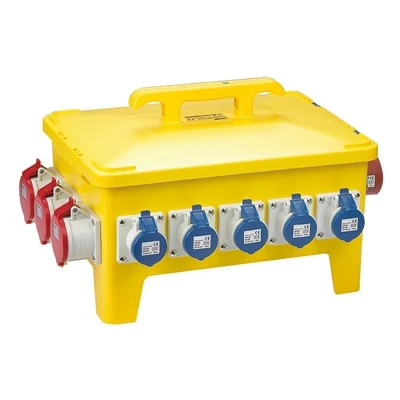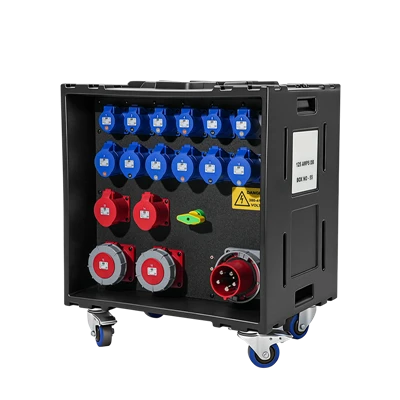
A power distribution box is used to receive electrical power from an upstream source and distribute it to multiple downstream circuits while providing switching, protection, monitoring, and controlled access to the outgoing supply.
For construction sites, stage and event power, temporary electrical systems, and outdoor industrial applications, selecting a distribution box requires more than choosing a current rating. The enclosure IP rating, electrical protection, connector type, number of outgoing circuits, installation method, operating environment, and emergency shutdown arrangement must all be considered together.
What Is a Power Distribution Box?
A power distribution box, also called a power distribution board or electrical distribution panel, is an enclosure containing electrical switching and protection devices used to divide one incoming power supply into several protected outgoing circuits.
A typical distribution system can be represented as:
Incoming Power → Main Protection → Metering → Distribution → Branch Protection → Loads
Depending on the application, a distribution box may contain:
Main circuit breaker
MCB
MCCB
RCD or RCCB
RCBO
Industrial sockets
Power connectors
Current transformers
Digital meters
Emergency stop
Neutral busbar
Earth busbar
Terminal blocks
Cable glands
Mechanical protection
Lockable breaker compartment
The actual configuration depends on the incoming supply, connected loads, installation environment, and applicable electrical requirements.
How Does a Power Distribution Box Work?
The basic function is to divide a larger incoming electrical supply into multiple downstream circuits.
For example, a high-current incoming supply may be connected to a main circuit breaker. The supply is then distributed through individual protective devices to several lower-current outlets.
How to Choose the Current Rating of a Power Distribution Box
Current rating is one of the first parameters to establish.
Common configurations may include:
16A
32A
63A
125A
250A
400A
800A
However, a larger current rating is not automatically better.
The required rating should be determined from:
Maximum demand
Continuous load current
Load diversity
Cable ampacity
Short-circuit current
Protection coordination
Supply voltage
Number of phases
Number and rating of outgoing circuits
Future load requirements
Typical Current Ranges and Applications
| Current Range | Typical Application |
|---|---|
| 16A | Small equipment, lighting and portable tools |
| 32A | Construction equipment and small temporary loads |
| 63A | Medium temporary power systems |
| 125A | Medium-sized equipment and downstream distribution |
| 250A | Large temporary power and event distribution |
| 400A | Large industrial or temporary power systems |
| 800A | Main distribution for large projects |
These are application examples rather than universal sizing rules. The final current rating must be verified against the actual electrical system.
How to Choose the Right IP Rating?
The IP rating describes the enclosure's resistance to ingress of solid foreign objects and water.
For distribution equipment, commonly specified ratings include:
IP44
IP54
IP65
IP67
The correct rating depends on the actual environment rather than simply selecting the highest available IP rating.
| IP Rating | General Protection | Typical Application |
| IP44 | Protection against objects ≥1 mm and splashing water | Indoor and general temporary applications |
| IP54 | Limited dust ingress and protection against water splashes | Industrial and general outdoor applications |
| IP65 | Dust-tight and protected against water jets | Outdoor and construction applications |
| IP67 | Dust-tight and protected against temporary immersion under specified test conditions | Wet and demanding outdoor environments |
IP65 vs IP67
IP65 and IP67 should not be treated as simply "lower" and "higher" versions of the same waterproofing requirement.
They address different water-ingress conditions.
IP65 is designed for protection against water jets, while IP67 includes protection against temporary immersion under specified test conditions.
Therefore:
The required IP rating should be selected according to the actual exposure to water, not only according to the numerical value.
A distribution box installed outdoors under rain may require a different configuration from one that can be temporarily exposed to standing water or immersion.
Does the Complete Distribution Box Still Meet Its IP Rating After Installation?
This is an important point during procurement.
The IP rating applies to the completed enclosure under the applicable test configuration. Openings for:
Cable glands
Industrial sockets
Push buttons
Emergency stops
Meters
Selector switches
Ventilation components
can affect the final protection level.
For example, an empty enclosure may be designed for IP65, but an improperly sealed cable entry can reduce the effective protection of the assembled unit.
Therefore, the following should be checked:
Door gasket
Cable gland rating
Connector sealing
Unused openings
Meter and switch mounting
Panel joints
Bottom cable entries
Drainage and condensation control
What Protection Devices Are Used in a Power Distribution Box?
Different protection devices perform different functions.
MCB
An MCB, or miniature circuit breaker, is commonly used for lower-current outgoing circuits.
Its main functions include protection against:
Overload
Short circuit
MCBs are commonly installed on individual socket or equipment circuits.
MCCB
An MCCB, or molded case circuit breaker, is generally used for higher-current circuits and main distribution.
Important selection parameters include:
Rated current
Rated voltage
Number of poles
Short-circuit breaking capacity
Thermal protection
Magnetic protection
Adjustable settings
Auxiliary contacts
For high-current distribution boxes, the MCCB may be used as the main incoming or major outgoing protective device.
RCD / RCCB
RCD and RCCB devices are used to detect residual current.
Their function differs from an MCB.
| Device | Primary Function |
| MCB | Overload and short-circuit protection |
| MCCB | Higher-current overload and short-circuit protection |
| RCD | Residual-current protection |
| RCCB | Residual-current protection |
| RCBO | Residual-current, overload and short-circuit protection |
An RCD/RCCB does not replace an MCB or MCCB for overcurrent protection unless the selected device specifically includes that function.
Why Is an Emergency Stop Used on a Distribution Box?
An emergency stop provides a means of rapidly initiating an emergency shutdown of the relevant electrical system or control circuit.
It may be required where an abnormal condition could create a safety risk.
Potential situations include:
Electrical faults
Equipment malfunction
Damaged cables
Abnormal equipment operation
Maintenance emergencies
Personnel safety incidents
The emergency stop circuit must be designed according to the electrical architecture.
Pressing an emergency-stop button does not necessarily mean that every component in the complete distribution system is disconnected. The actual switching point depends on how the emergency circuit is designed.
What Is a Stage Power Distribution Box?
A stage power distribution box is designed to distribute electrical power to multiple loads used for temporary events, stage equipment, lighting, audio systems, video equipment, and other event infrastructure.
A high-current stage distribution configuration may include:
High-Current Input → Main Protection → Metering → Branch Protection → Industrial Outlets
It may also provide high-current outputs for connection to downstream distribution units.
For example, a system with a 250A incoming supply may distribute power through several 32A branch circuits while maintaining additional high-current outputs for downstream equipment.
The key design considerations include:
Incoming current
Outgoing circuit ratings
Phase balancing
RCD protection
MCB protection
Metering
Emergency stop
Connector configuration
Mechanical protection
Portability
Cable management
The number of outlets should not be considered separately from the total available power and phase loading.
What Is a Construction Site Power Distribution Board?
Construction sites typically use temporary power distribution equipment to supply:
Power tools
Lighting
Pumps
Compressors
Welding equipment
Temporary site facilities
Portable machinery
Construction environments can expose electrical equipment to:
Dust
Rain
Mud
Mechanical impact
Frequent movement
Cable damage
Temporary installation conditions
Therefore, the distribution board should be selected based on both electrical requirements and the physical environment.
Depending on the installation, important features may include:
Suitable IP rating
RCD protection
MCB protection
Lockable breaker compartment
Emergency stop
Impact-resistant enclosure
Industrial sockets
Cable glands
Earth connection
Portable wheels or handles
How to Choose a Waterproof Distribution Box for Outdoor Applications?
For outdoor applications, IP rating is only one part of the selection process.
The enclosure material and construction also affect long-term performance.
Important factors include:
Ambient temperature
UV exposure
Rain
Dust
Humidity
Condensation
Chemical exposure
Mechanical impact
Installation position
Cable-entry method
For example, a distribution box installed under a roof but exposed to dust and occasional rain may have different requirements from equipment installed in an area where temporary water immersion is possible.
Stainless Steel vs Engineering Plastic Distribution Boxes
The enclosure material should be selected according to the operating environment and mechanical requirements.
| Factor | Stainless Steel | Engineering Plastic |
| Mechanical strength | Generally high | Depends on material and construction |
| Weight | Higher | Generally lower |
| Corrosion resistance | High with suitable grade and finish | Generally good, depending on material |
| Electrical insulation | Requires appropriate grounding of conductive enclosure | Naturally electrically insulating |
| Portability | Lower | Higher |
| Impact resistance | Depends on thickness and construction | Depends on material and wall design |
| Outdoor suitability | Suitable with appropriate finish | Suitable when UV and temperature requirements are met |
| Construction applications | Suitable for heavy-duty configurations | Suitable for portable configurations |
304 stainless steel may be selected where mechanical strength, corrosion resistance, and repeated handling are important.
Engineering plastics may be selected where lower weight, electrical insulation, and portability are priorities.
Neither material is universally better. The correct choice depends on the application.
What Does IK10 Mean on a Power Distribution Box?
IP and IK ratings describe different properties.
IP rating → ingress protection
IK rating → mechanical impact protection
IK10 represents a high level of mechanical impact resistance under the applicable test conditions.
This can be important for distribution boxes used in:
Construction sites
Stage installations
Temporary power systems
Industrial environments
Public areas
Equipment exposed to mechanical handling
A high IK rating does not automatically mean a higher IP rating.
Both ratings should be specified separately when both water protection and mechanical impact resistance are required.
What Is IEC 60309 and Why Is It Used for Industrial Distribution?
IEC 60309 is associated with industrial plugs, socket-outlets, connectors, and appliance couplers.
Industrial distribution equipment may use IEC 60309 connections for temporary and industrial power applications.
Selection parameters include:
Rated current
Rated voltage
Number of poles
Frequency
Earthing arrangement
Environmental protection
Connector configuration
Common current ratings include:
16A
32A
63A
125A
The connector rating must match the circuit protection, cable capacity, and connected load.
For high-current distribution equipment, the incoming and outgoing connector arrangement should also be checked against the complete power distribution architecture.
What Is a Powerlock Connection?
Powerlock-type connectors are used for high-current electrical connections where rapid connection and disconnection are required.
They are commonly considered for applications involving:
Temporary power
Events
Stage equipment
Generators
Large distribution systems
Industrial equipment
When selecting a high-current connector system, the engineer should confirm:
Current rating
Voltage rating
Number of poles
Phase arrangement
Grounding method
Connector compatibility
Cable size
Environmental protection
Mechanical locking method
The connector should be selected as part of the complete electrical system rather than as an isolated component.
How Should Phase Loading Be Considered?
A three-phase distribution box can have several single-phase outgoing circuits.
For example:
L1 → Multiple 230V loads
L2 → Multiple 230V loads
L3 → Multiple 230V loads
If most loads are connected to one phase, the system can become unbalanced.
Phase imbalance can result in:
Unequal phase currents
Increased neutral current
Uneven loading of the upstream supply
Reduced available capacity on one phase
Therefore, the outgoing circuits should be distributed across the available phases according to the expected load.
For a project-specific distribution box, phase allocation should be confirmed from the actual connected loads rather than from socket count alone.
Portable vs Wall-Mounted Distribution Panels
Installation method is another important selection factor.
| Feature | Portable Distribution Board | Wall-Mounted Panel |
| Movement | Designed for relocation | Fixed installation |
| Typical use | Construction and events | Industrial and building systems |
| Enclosure | Plastic or metal | Plastic or metal |
| Cable management | Often important | More structured |
| Installation | Temporary | Permanent or semi-permanent |
| Protection | Depends on application | Depends on environment |
| Maintenance access | Often front access | Front access |
| Handles/wheels | May be required | Normally not required |
Portable equipment should also consider:
Handle design
Weight
Cable storage
Mechanical protection
Connector accessibility
Stability during operation
How to Configure a Power Distribution Box for a Project?
For a customized project, the configuration should be developed from the electrical load schedule.
The design process can follow these steps:
Step 1: Define the Incoming Supply
Confirm:
Voltage
Frequency
Number of phases
Maximum current
Connector type
Earthing arrangement
Step 2: Define the Loads
List:
Equipment
Rated power
Operating current
Starting current
Phase
Duty cycle
Step 3: Define the Outgoing Circuits
Determine:
Number of circuits
Outlet type
Outlet current
Circuit protection
Cable requirements
Step 4: Select Protection
Select:
Main breaker
Branch MCBs
MCCBs
RCD/RCCB/RCBO
Overload protection where required
Step 5: Select the Enclosure
Confirm:
IP rating
IK rating
Material
Dimensions
Mounting method
Temperature range
Corrosion requirements
Step 6: Design Cable Entry
Confirm:
Cable diameter
Cable gland type
Entry direction
Number of entries
Sealing requirements
Step 7: Verify Documentation and Testing
Prepare:
General arrangement drawing
Single-line diagram
Wiring diagram
Bill of materials
Component datasheets
Inspection plan
FAT procedure
What Information Should Be Included in a Power Distribution Box RFQ?
A complete RFQ should provide enough information for the supplier to configure the electrical and mechanical system correctly.
The purchaser should ideally specify:
| Category | Information |
| Electrical Supply | Voltage |
| Frequency | |
| Phase | |
| Maximum current | |
| Main Input | Connector type |
| Current rating | |
| Outlets | Quantity |
| Voltage | |
| Current | |
| Connector type | |
| Protection | MCB |
| MCCB | |
| RCD/RCCB | |
| Monitoring | Voltmeter |
| Ammeter | |
| Energy meter if required | |
| Safety | Emergency stop |
| Lockable breaker compartment | |
| Enclosure | IP rating |
| IK rating | |
| Material | |
| Dimensions | |
| Environment | Temperature |
| UV exposure | |
| Rain/water exposure | |
| Installation | Portable or wall-mounted |
| Customization | Internal configuration |
| Compliance | Applicable standards |
| Commercial | Quantity |
| MOQ | |
| Lead time | |
| Incoterm |
The more complete the RFQ is, the easier it is to compare supplier quotations on a technical basis.