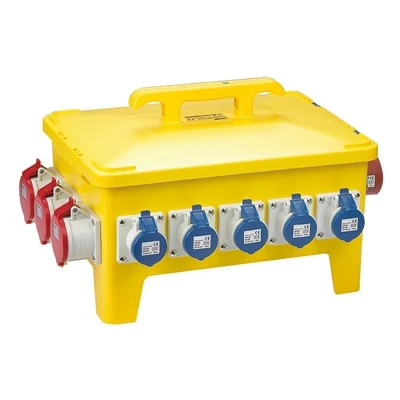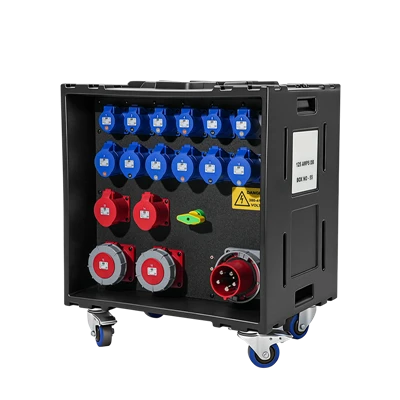
A Portable 400 Amp Distro Box for Construction and Events should be evaluated as part of a complete temporary power distribution system rather than as an isolated electrical enclosure. The important engineering factors include the 400A incoming path, busbar construction, branch protection, cable sizing, phase balancing, voltage drop, grounding, RCD/GFCI protection, enclosure IP rating, thermal behavior, and mechanical handling.
For construction sites and outdoor events, the actual operating conditions-such as variable loads, long cable runs, rain, dust, repeated relocation, motor starting currents, and continuous high-current operation-often determine the required configuration more than the nominal 400A rating itself.

What Is a Portable 400 Amp Distro Box?
A Portable 400 Amp Distro Box is a temporary electrical distribution assembly designed to receive a high-current power supply and divide it into multiple protected branch circuits for construction sites, outdoor events, temporary facilities, and mobile power systems. A typical configuration includes a 400A main incoming connection, main circuit breaker or disconnect, copper or aluminum busbars, branch circuit breakers, neutral and earth bars, cable glands, and IEC 60309 industrial outlets. The enclosure is commonly fabricated from powder-coated steel, stainless steel, or impact-resistant polymer materials, depending on whether the unit is intended for fixed site use or repeated transportation.
In a typical installation, power flows from a generator or temporary utility supply → 400A incoming cable → main disconnect → busbar assembly → branch protection → industrial outlets → downstream equipment. The enclosure must maintain mechanical protection while carrying substantial current; therefore, conductor cross-section, terminal temperature rise, enclosure ventilation, IP rating, and cable bending radius are practical design parameters rather than cosmetic specifications.
Internal Structure of a 400 Amp Distro Box
The main current path normally consists of an incoming terminal assembly, main protective device, copper busbars, and outgoing circuit protection. For a three-phase system, the busbar arrangement generally includes L1, L2, L3, and N, with a separate PE/earth bar. Copper is commonly selected for busbars because its electrical conductivity and thermal characteristics allow relatively compact conductor dimensions at high current ratings.
The internal layout also affects field maintenance. The main breaker is normally positioned close to the incoming terminals, while branch breakers are arranged downstream so that individual circuits can be isolated without disconnecting the entire distribution box. Cable entry points require appropriately sized cable glands, and the enclosure must provide sufficient clearance around live components to prevent accidental contact and allow inspection with the equipment de-energized.
How Power Is Distributed Through a 400 Amp Distro Box
During a construction-site installation, the incoming supply is connected to the main terminals and passes through the 400A main disconnect or MCCB before reaching the busbar. Branch breakers then divide the available power into separate circuits, for example temporary lighting, welding equipment, pumps, compressors, HVAC units, battery chargers, and site cabins.
For a three-phase distribution system, loads should be assigned across L1, L2, and L3 rather than concentrating most single-phase loads on one phase. A field electrician can measure the current on each phase with a clamp meter while major equipment is operating. If one phase consistently carries substantially more current than the others, branch circuits can be rearranged to reduce phase imbalance and unnecessary heating in the conductors and connections.
400 Amp Distro Box for Construction Sites
Construction sites normally experience changing electrical loads because equipment is connected and disconnected throughout the workday. A typical temporary power sequence may involve a generator supplying the distro box, followed by distribution to site offices, lighting circuits, pumps, compressors, welding machines, tools, and temporary HVAC equipment.
The physical environment is also different from an indoor electrical room. The distribution box may be exposed to rain, concrete dust, mud, mechanical impact, cable pulling forces, and repeated relocation. For this reason, an outdoor construction configuration normally requires a weather-resistant enclosure, sealed cable entries, protected outlets, robust hinges and locks, and an appropriate IP rating. The required IP level should be selected according to the actual exposure to water and dust rather than using IP terminology as a generic marketing label.
400 Amp Distro Box for Outdoor Events
Temporary events create a different load profile because the equipment may include stage lighting, audio systems, LED displays, catering equipment, temporary refrigeration, broadcast equipment, and portable HVAC units. Many of these loads operate simultaneously for several hours, while some equipment can introduce significant starting or inrush currents.
A typical event power layout is generator → 400A distro box → sub-distribution boxes → equipment circuits. The distro box therefore acts as the central point for circuit separation and protection. Branch outlets can be configured with different current ratings according to the downstream equipment, such as 16A, 32A, 63A, 125A, or other project-specific configurations, provided that the protective devices, conductors, connectors, and outlets are correctly coordinated.
Load Balancing in a 400 Amp Distro Box
Three-phase load balancing becomes important when the distro box supplies a combination of single-phase and three-phase equipment. A single-phase load connected between L1 and N draws current primarily from L1, while another identical load connected between L2 and N draws from L2. If too many branch circuits are concentrated on one phase, the phase currents can become significantly different.
In practice, an electrician can record L1, L2, and L3 current values under normal operating conditions and compare them before moving branch circuits. For example, if measurements show approximately 180A on L1, 105A on L2, and 95A on L3, some single-phase loads can potentially be reassigned from L1 to L2 or L3, subject to the circuit design. Load balancing must be performed according to the actual circuit configuration rather than simply dividing the nominal 400A rating by three.
Cable Selection and Voltage Drop
A 400A rating on the distribution box does not by itself determine the cable size for every installation. Cable selection depends on conductor material, installation method, cable length, ambient temperature, grouping, insulation temperature rating, allowable voltage drop, and local electrical regulations.
For example, a generator located 80–100 m from a construction distribution point creates a different voltage-drop condition from a generator positioned 10 m away. The installation engineer needs to evaluate the current-carrying capacity and voltage drop of the complete cable route. Flexible rubber cables may be selected for temporary installations because they can tolerate repeated handling and bending, but the final conductor size must be calculated for the actual load and installation conditions.
Preventing Overheating Inside a 400 Amp Distro Box
Heat generation in a high-current distribution box is closely related to electrical resistance. Loose terminals, undersized conductors, damaged contacts, or poorly tightened connections can create localized resistance and therefore localized heating. The problem may appear first at cable lugs, breaker terminals, busbar joints, or industrial plug contacts rather than across the entire enclosure.
During maintenance, technicians can inspect terminal torque, conductor condition, discoloration, insulation deformation, and abnormal temperature rise. Infrared thermography can also be used while the system is energized to identify unusually hot connection points. A localized temperature increase at one terminal compared with adjacent terminals is a practical indication that the connection should be investigated rather than simply assuming that the entire 400A system is overloaded.
Protection Against Rain, Dust, and Construction Debris
Outdoor distro boxes need mechanical and environmental protection because water and conductive contamination can affect insulation resistance and electrical clearances. Enclosures may use gasketed doors, sealed cable glands, covered outlets, and corrosion-resistant hardware to reduce the possibility of water or dust reaching energized components.
The appropriate IP rating depends on the installation environment and enclosure construction. For example, an enclosure installed under a temporary roof has a different exposure level from one positioned directly beside an outdoor stage or construction area. Cable entries are particularly important because an enclosure with a sealed door can still lose its intended ingress protection if incorrectly sized or poorly installed cable glands leave open paths around incoming and outgoing cables.
Grounding and Earth Connections
A portable 400A distribution system normally incorporates a dedicated PE/earth bar connected to the protective earthing system. The incoming supply, metallic enclosure where applicable, and downstream protective conductors must be connected according to the electrical system design and applicable local regulations.
On a construction site, the earth connection should be verified before energizing downstream circuits. Where the system is supplied by a generator, the relationship between the generator neutral, protective earth, bonding arrangement, and distribution equipment must be established correctly. The correct configuration depends on the generator and earthing system, so the installation should not rely on a generic assumption that neutral and earth can always be bonded inside the distro box.
RCD and GFCI Protection for Temporary Power
Temporary construction and event power systems often supply portable equipment that can be exposed to moisture, damaged cables, or frequent connection and disconnection. Residual-current protection can be incorporated into selected branch circuits to detect current imbalance between live conductors and the return path.
For example, a 30 mA RCD may be required for certain personnel-protection applications depending on the local electrical code and circuit type. The protection device must be coordinated with the downstream circuit rating and tested according to the applicable standard. RCD protection should not be treated as a replacement for correct grounding, insulation, overcurrent protection, or proper cable selection.
Moving and Positioning a Portable 400 Amp Distro Box
A portable 400A distro box can become mechanically demanding to move because the enclosure, copper busbars, circuit breakers, connectors, and incoming cables add substantial mass. Larger units may therefore use wheels, lifting points, handles, reinforced frames, or forklift-access provisions.
Before relocation, the electrical supply must be isolated and disconnected, and attached cables should be removed or secured to prevent connector damage. On uneven construction surfaces, the enclosure should be positioned so that wheels or support feet remain stable and cable connections are not subjected to continuous lateral pulling forces.
Maintenance of a Portable 400 Amp Distro Box
Maintenance should focus on components that experience electrical loading and mechanical handling: main breaker terminals, busbar joints, branch breakers, cable lugs, IEC 60309 outlets, cable glands, door seals, earth connections, and mechanical fasteners.
A practical inspection can include visual examination for discoloration or insulation damage, verification of connection tightness according to the component manufacturer's torque specification, RCD functional testing where applicable, inspection of enclosure seals, and measurement of operating currents. For equipment used repeatedly at temporary sites, inspection should be based on operating hours, relocation frequency, environmental exposure, and applicable electrical regulations rather than using an arbitrary calendar interval alone.
Common Problems in 400 Amp Temporary Power Distribution
Several problems can be identified through observable field conditions:
| Field symptom | Possible cause | Inspection point |
|---|---|---|
| Main breaker trips | Excessive load or short circuit | Incoming current and downstream circuits |
| One terminal becomes hot | Loose/high-resistance connection | Cable lug and terminal |
| Voltage drops at equipment | Long cable run or undersized conductor | Cable length, conductor size, load current |
| One phase carries much higher current | Poor load distribution | L1/L2/L3 measurements |
| RCD trips repeatedly | Leakage current or insulation problem | Downstream equipment and cables |
| Water found inside enclosure | Incorrect cable gland or damaged seal | Door gasket and cable entries |
| Outlet becomes discolored | Overheating/contact resistance | Plug and socket contacts |
| Breaker trips when motor starts | High starting/inrush current | Motor starting characteristics |
This troubleshooting approach links the observable symptom → electrical parameter → physical component, which is more useful for site technicians than simply listing generic safety recommendations.
How to Select a Portable 400 Amp Distro Box
Selection should begin with the actual power source and downstream loads rather than the nominal "400 Amp" label. The engineer should establish the system voltage, phase configuration, maximum demand current, generator or utility capacity, cable length, branch circuit ratings, environmental conditions, connector types, and required protection devices.
For construction applications, mechanical durability, weather protection, cable handling, and easy access to breakers are often important design parameters. For event applications, the number and type of outlets, rapid circuit identification, portability, generator compatibility, and repeated setup/teardown should be considered. The final configuration should match the applicable electrical standards and the requirements of the country where the equipment will be installed.
Portable 400 Amp Distro Box: Typical Application Flow
A typical temporary power installation can be organized into the following sequence:
Power Source → Main Incoming Cable → 400A Main Protection → Copper Busbar → Branch Circuit Protection → IEC 60309 / Other Industrial Outlets → Sub-Distribution → End Equipment
At the commissioning stage, the electrician verifies the incoming voltage and phase sequence, checks protective-earth continuity, confirms breaker and RCD operation where applicable, measures phase currents under load, and inspects cable connections. After the system is energized, current and temperature conditions can be monitored while major equipment starts and reaches its normal operating load.
This process allows the distro box to be evaluated under the actual operating conditions rather than only by its nameplate rating.
Key Technical Parameters to Check Before Purchase
| Parameter | What to verify |
|---|---|
| Rated current | 400A or project-specific rating |
| System voltage | Match generator/utility supply |
| Phase configuration | Single-phase / three-phase |
| Main protection | MCCB, switch-disconnector, or project-specific device |
| Busbar material | Copper or specified conductor material |
| Branch protection | MCB/MCCB/RCD configuration |
| Outlet configuration | IEC 60309 or other required connectors |
| Enclosure | Steel, stainless steel, polymer, etc. |
| Ingress protection | Select according to actual site exposure |
| Cable entry | Gland size and cable diameter range |
| Grounding | PE bar and external earth connection where required |
| Mobility | Wheels, handles, lifting points |
| Operating environment | Indoor, outdoor, wet, dusty, construction site |
| Temperature | Ambient temperature and equipment temperature rise |
| Maintenance | Access to breakers, terminals, busbars and seals |