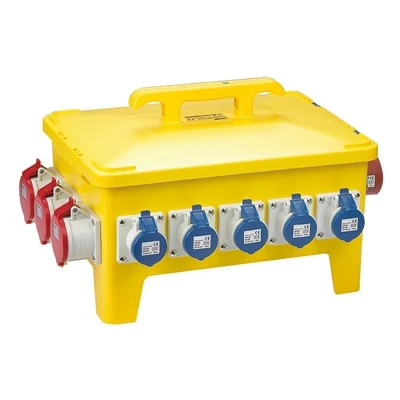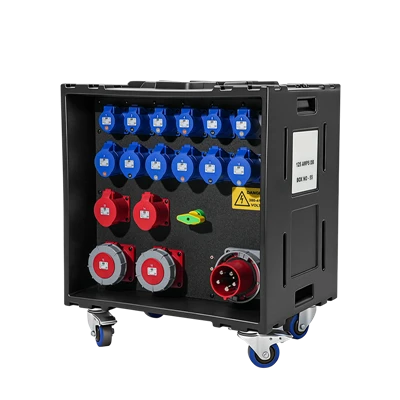
In building construction, temporary power distribution boxes and mobile power distribution boxes serve different functions even though both distribute low-voltage electrical power on-site.
The main difference is:
Temporary power distribution boxes act as fixed or semi-fixed site power nodes
Mobile power distribution boxes are designed for frequent movement with portable equipment and temporary work areas
Their enclosure structure, protection configuration, cable design, and mechanical reinforcement are different because the operating conditions are different.
What Is a Temporary Power Distribution Box
A temporary power distribution box receives power from:
Utility temporary service connections
Diesel generators
Main construction switchboards
It distributes electricity to:
Tower cranes
Welding equipment
Site lighting
Concrete pumps
Worker accommodation areas
These boxes are usually installed at fixed construction zones for weeks or months.
Typical structure includes:
Steel enclosure
Internal copper busbar
MCCB main breaker
Multiple branch MCBs
Grounding terminal bar
Common ratings range from:
63A
125A
250A
400A
What Is a Mobile Power Distribution Box
A mobile power distribution box is designed for portable field power access.
It is commonly used with:
Portable grinders
Hand tools
Temporary lighting
Mobile welding stations
Maintenance equipment
These units are frequently moved between floors or work zones.
Typical structure includes:
Compact enclosure
Carry handles or wheels
Flexible cable input
Multiple industrial sockets
Integrated RCBO protection
Most mobile units use:
16A
32A
63A
ratings.
Structural Design Differences
| Design Area | Temporary Distribution Box | Mobile Distribution Box |
|---|---|---|
| Installation | Fixed/semi-fixed | Portable |
| Enclosure Material | Powder-coated steel | ABS/polycarbonate/rubber |
| Internal Structure | Busbar-based | Cable-wired |
| Weight | Heavy | Lightweight |
| Mechanical Protection | Impact resistant | Drop resistant |
Temporary systems prioritize current capacity and branch distribution.
Mobile systems prioritize portability and cable flexibility.
Power Input and Output Configuration
Temporary construction boxes usually use:
Bottom cable entry
Large feeder terminals
Busbar connections
Multi-circuit branch outputs
Mobile boxes commonly use:
Plug-and-socket input
Flexible rubber cable
Portable outlet configuration
Typical mobile outputs include:
230V Schuko sockets
IEC 60309 industrial sockets
Protection Device Differences
Temporary site distribution boxes commonly contain:
| Device | Function |
|---|---|
| MCCB | Main feeder protection |
| MCB | Branch circuit protection |
| SPD | Surge protection |
| Phase monitor | Voltage monitoring |
Mobile distribution boxes typically focus on personnel protection.
Common devices include:
| Device | Function |
|---|---|
| RCBO | Leakage + overload protection |
| RCCB | Electric shock protection |
| MCB | Tool circuit protection |
Mobile systems often use 30mA leakage trip sensitivity because operators directly handle connected equipment.
Environmental Protection Requirements
Temporary construction distribution boxes are exposed to:
Rain
Cement dust
Mud
UV exposure
Common protection ratings:
IP44
IP65
IP67
Mobile distribution boxes additionally require:
Impact resistance
Cable bending resistance
Connector sealing during repeated movement
Rubber edge protection is common in portable units.
Mobility and Mechanical Design
Mobile distribution boxes are designed for repeated transport.
Common mechanical features include:
Carry handles
Steel frame protection
Wheel assemblies
Reinforced corners
Temporary fixed boxes usually use:
Wall mounting brackets
Floor stands
Crane lifting points
Large 250A–400A systems may require forklift movement.
Cable Management Differences
Temporary site boxes often use:
Large-diameter feeder cables
Cable trench routing
Fixed cable clamps
Mobile boxes use:
H07RN-F flexible rubber cable
Quick-disconnect plugs
Portable extension assemblies
Repeated cable bending is a major failure mode in mobile systems.
Cable entry points therefore use strain relief glands.
Typical Construction Applications
Temporary Distribution Boxes
Typical applications:
Main site power distribution
Multi-floor construction supply
Crane power systems
Concrete batching areas
Mobile Distribution Boxes
Typical applications:
Portable power tools
Maintenance work
Temporary repair zones
Interior finishing work
FAQ
Why are mobile distribution boxes smaller?
Portable systems supply localized loads such as hand tools and temporary lighting, so they require lower current capacity and lighter enclosure structures.
Why do temporary distribution boxes use busbars?
Busbars distribute high current more efficiently than flexible cable wiring and reduce thermal rise in multi-circuit systems.
Why do mobile power boxes use RCBO protection?
Portable equipment is handled directly by workers. RCBO devices disconnect power quickly during leakage or electric shock conditions.